Free tool · PhD planning
PhD rules by university
Pick a university, or two to compare, and see its PhD rules on one card beside the UGC 2022 minimum.
Pick a university and this tool shows its PhD rules on one card. You get the marks you need, the entrance test and who skips it, and the coursework. You also get the minimum and maximum duration, the papers you need before you submit, the similarity limit and the thesis format. Pick a second university to see the two side by side, with the rules that differ marked. The UGC 2022 minimum sits beside them, so you can see where a university asks for more.
It covers 20 universities that we have written guides for. It is for choosing where to apply, and for checking a rule you heard from a senior. Every rule comes from one of our guides, and each guide cites the university’s own document.
Every university’s rules
Open a university to see its card. Each rule gives the clause where our guide names one. Jump to:
- Anna University
- Annamalai University
- Banaras Hindu University (BHU)
- Bangalore University
- Bharathiar University
- Bharathidasan University
- JNTU Hyderabad (JNTUH)
- Jawaharlal Nehru University (JNU)
- Madurai Kamaraj University
- Manonmaniam Sundaranar University
- Osmania University
- Savitribai Phule Pune University (SPPU)
- University of Calcutta
- University of Calicut
- University of Delhi
- University of Hyderabad
- University of Kerala
- University of Madras
- University of Mumbai
- Visvesvaraya Technological University (VTU)
UGC 2022 minimum (every university)
- Eligibility (master’s marks)
A master’s with 55%, or a four-year bachelor’s with 75%. An M.Phil. with 55% also counts. SC, ST, OBC (non-creamy layer), differently-abled, EWS and other groups UGC names get 5% off (clause 3).
- Entrance test and NET/JRF
Two routes (clause 5(2)). Fellowship holders from UGC-NET, CSIR-NET, GATE, CEED or a similar national test are admitted on an interview. A university entrance test is half research methodology, half subject. You need 50% (45% with relaxation) to reach the interview, and selection is 70% test, 30% interview. Since 2024, NET results can also be used for PhD admission alone.
- Coursework
At least 12 credits, including a research methodology course and Research and Publication Ethics (clause 9(1)). You need 55% to go on (clause 9(3)). Your Research Advisory Committee may count UGC-recognised online courses.
- Duration: full-time
At least three years including coursework, and at most six (clause 4(1)). Re-registration can add up to two years, to a total of eight. Women and persons with more than 40% disability may get two more, to ten (clause 4(2)).
- Duration: part-time
The same as full-time: three years minimum, coursework included, and six maximum, plus up to two by re-registration. Universities may set a longer minimum for part-time scholars.
- Papers before submission
None. The 2022 regulations have no clause on publishing before submission. The 2016 regulations (clause 9.4) asked for one refereed journal paper and two conference presentations. Your university may still ask for papers.
- Similarity limit
Set by a separate rule, the UGC plagiarism regulations of 2018. Up to 10% is Level 0, with no penalty. Above 10% to 40% means a revised thesis within six months. Above 40% to 60% bars a revised script for a year, and above 60% cancels registration (Regulations 8 and 12.1).
- Thesis format
Our guides quote no layout rule from UGC 2022. Clause 11 asks for the thesis to go in with a no-plagiarism undertaking and the supervisor’s certificate of originality. Your university sets the format.
From our guides:
- PhD admission in India
- Part-time PhD in India: rules, eligibility and the employer NOC
- PhD coursework and the RPE course
- PhD timeline and milestones in India
- Is publication mandatory for a PhD in India after UGC 2022?
- Plagiarism limits for PhD theses in India
Documents behind this card:
Anna University
- Eligibility (master’s marks)
A master’s with 55%, or a CGPA of 5.5 out of 10. SC, ST and candidates with more than 40% disability need 50% or 5.0. The degree must match the faculty you apply to (clause 2).
- Entrance test and NET/JRF
A two-hour written test: 25% research methodology, 75% your PG subject. You need 50% to reach the interview, with 5% relaxation for SC, ST and more than 40% disability. Rank is 70% test, 30% interview (clause 5.3). A valid GATE score or NET frees you from the test, and that score takes its place (clause 5.4).
- Coursework
Four PG courses worth 12 credits that you did not take in your master’s, or up to four Swayam-NPTEL PG courses. You get two attempts per course and three years at most. A CGPA of 7.0, a written and oral exam and a seminar confirm your registration (clause 13.1).
- Duration: full-time
Minimum two years in Engineering and Technology, and in Architecture and Planning. Three years in Science and Humanities. In Management, two with an engineering first degree and three with a science or humanities one. Maximum six years in every case (clauses 10.2 and 10.3).
- Duration: part-time
Minimum three years in Engineering and Technology, and in Architecture and Planning. Four years in Science and Humanities. In Management, three with an engineering first degree and four with a science or humanities one. Maximum six years (clauses 10.2 and 10.3).
- Papers before submission
At least one full-length research article, published after joining, in a regular issue of a journal on the Centre for Research list. One granted Indian utility patent can count instead. It is needed before the synopsis is accepted (clause 16.2). Two are needed to submit three months early (clause 16.1).
- Similarity limit
CFR’s plagiarism policy has you submit the similarity report after reaching Level 0, which is up to 10%. References, contents, acknowledgements, standard equations and your own claimed papers are left out of the count.
- Thesis format
A4, Times New Roman 13 at 1.5 spacing, on CFR’s official Word or LaTeX template. The main text runs 100 to 400 pages. References are author–year, close to Harvard. English and Tamil abstracts of about 400 words go in with the thesis.
Our guide: Anna University PhD admission. Thesis format: Anna University PhD thesis format. Official regulation: Ph.D. Regulations R2025.
Documents behind this card:
Annamalai University
- Eligibility (master’s marks)
A master’s with 55%, or a CGPA of 5.5 out of 10. SC, ST, OBC (non-creamy layer) and differently abled candidates need 50% or 5.0 (clause 2). Open University master’s degrees are not accepted.
- Entrance test and NET/JRF
A test of 70 one-mark questions in 90 minutes, then a 30-mark interview. You need 50% of the 100, or 45% with the reserved-category relaxation (clause 6.6). M.Phil., teacher fellowship, UGC-JRF, NET, SLET, SET, GATE, CSIR, ICHR, ICPR and ICSSR holders skip the test, not the interview.
- Coursework
At least four or five courses of four credits, including Research Methodology (4) and Research and Publication Ethics (2). You need 50% in each exam and 80% attendance, with three attempts. Finish within 18 months, extendable by six (clause 14).
- Duration: full-time
Minimum three years, or two with an M.Phil. The maximum is six years, with one grace year.
- Duration: part-time
Minimum four years; the synopsis can go in three months before it ends (clause 17.1). The maximum is six years, with one grace year.
- Papers before submission
Two papers, published or accepted, carrying the Annamalai affiliation, before the synopsis. They must be in SCI, SCI-E, SSCI or Scopus Q1–Q4 journals, or double-blind peer-reviewed ones (clauses 17.1 and 17.3).
- Similarity limit
The 2026-27 regulations give no similarity percentage and name no software. Clause 26 covers only what happens if plagiarism is found. Only the ICAR stream in agriculture names a tool (Turnitin) and the percentage UGC prescribes.
- Thesis format
Times New Roman 13 pt at 1.5 spacing, on A4 of at least 80 GSM (Appendix II). No more than 300 pages, leaving out bibliography and appendices, unless the Director, DARE agrees (clause 18.8). Four double-sided soft-cover copies, each with a CD.
Our guide: Annamalai University PhD admission. Thesis format: Annamalai University PhD thesis format. Official regulation: Ph.D. Prospectus 2026-27 (University Departments), with the regulations.
Documents behind this card:
Banaras Hindu University (BHU)
- Eligibility (master’s marks)
55% in the qualifying degree, or 60% in the Faculty of Management Studies. SC, ST, OBC and PwBD candidates get 5% relaxation (2026 bulletin).
- Entrance test and NET/JRF
BHU holds no Research Entrance Test. In JRF mode, the interview alone decides. In NET mode, merit is 70% your NET, GATE or ICAR-SRF percentile and 30% your interview percentile. The NET result must be declared within the last year. The interview is 30 marks, in person (2026 bulletin).
- Coursework
At least 16 credits over at least two semesters, finished within four semesters of paying your fees (clause X). One exam covers the whole coursework, and you need 50% in each part.
- Duration: full-time
At least three years from joining. Extensions of up to two years, plus a third year from the Dean, take the total to six. Re-registration can add two more (clause VIII).
- Duration: part-time
At least four years for senior managers admitted part-time (clause VIII). The guide gives no separate figure for other part-time routes.
- Papers before submission
Not stated in the regulations we checked. See the official regulation. Ph.D. Ordinance (2016, as amended)
- Similarity limit
Not stated in the regulations we checked. See the official regulation. Ph.D. Ordinance (2016, as amended)
- Thesis format
Not stated in the regulations we checked. See the official regulation. Ph.D. Ordinance (2016, as amended)
Our guide: BHU PhD admission. Official regulation: Ph.D. Ordinance (2016, as amended).
Documents behind this card:
Bangalore University
- Eligibility (master’s marks)
A master’s with 55%, or 75% in a four-year bachelor’s. SC, ST, Category-I, OBC (non-creamy layer) and PwD candidates get 5% relaxation (clause 3). An M.Phil. counts only if earned in regular mode on or before 2009, with 55%.
- Entrance test and NET/JRF
A 100-mark test in 120 minutes: 50% research methodology, 50% subject. You need 50% (45% reserved) to reach the interview. The final score is 70% test, 30% interview (clause 5.3). Fellowship holders are selected on the interview alone (5.1.1). NET, KSET, SLET and GATE holders skip the test but are ranked (5.2). Half the seats go to each stream (11.6.4).
- Coursework
Three four-credit papers in one semester, attended full-time: Research Methodology and Publication Ethics, a cognate or core paper, and a paper in your supervisor’s field (clause 12). You need 50% in each paper, 55% overall and 75% attendance.
- Duration: full-time
Not stated in the regulations we checked. See the official regulation. Regulations Governing the Degree of Doctor of Philosophy, 2024
- Duration: part-time
Not stated in the regulations we checked. See the official regulation. Regulations Governing the Degree of Doctor of Philosophy, 2024
- Papers before submission
Not stated in the regulations we checked. See the official regulation. Regulations Governing the Degree of Doctor of Philosophy, 2024
- Similarity limit
Not stated in the regulations we checked. See the official regulation. Regulations Governing the Degree of Doctor of Philosophy, 2024
- Thesis format
Not stated in the regulations we checked. See the official regulation. Regulations Governing the Degree of Doctor of Philosophy, 2024
Our guide: Bangalore University PhD admission. Official regulation: Regulations Governing the Degree of Doctor of Philosophy, 2024.
Documents behind this card:
Bharathiar University
- Eligibility (master’s marks)
A master’s with 55% (grade B on the UGC seven-point scale), with 17 years of study behind it (clause 2.1). SC, ST, differently-abled and other groups Tamil Nadu names get 5% relaxation. M.E., M.Tech. and PG degrees in medicine, law and agriculture are not accepted (clause 2.2).
- Entrance test and NET/JRF
The Common Eligibility Test has 50 one-mark questions, no negative marking, and a pass mark of 15. Selection is out of 100: PG marks (50), CET (50) and interview (10). You need 50 overall, with 25 from PG and 25 from CET plus interview. UGC-NET or CSIR-NET (JRF included), SLET, SET, GATE, DST-INSPIRE, M.Phil. and FIP or FDP holders skip the CET.
- Coursework
Part I has three papers: research methodology, an advanced course and a special paper (clause 18.1). Each is three hours and 100 marks. You need 50 in each and 55% overall, within five attempts. An M.Phil. in the same area exempts you.
- Duration: full-time
At least three years, including coursework, with 75% attendance each year. An M.Phil. or M.Litt. in a related subject takes a year off. The guide gives no maximum.
- Duration: part-time
At least four years. An M.Phil. or M.Litt. in a related subject takes a year off. The guide gives no maximum.
- Papers before submission
At least two papers in SCI, SCIE or Scopus journals, or peer-reviewed ones (SSCI, AHCI or Scopus for arts, humanities and social sciences). Also two conference or seminar talks. Proceedings papers don’t count. Accepted papers are enough for the synopsis.
- Similarity limit
A maximum of 10% on DrillBit, checked on the chapters only. The certified certificate is valid for 15 days from the date of issue.
- Thesis format
The regulations fix the cover, certificates and copies, but not margins, fonts or citation style. The main text must not go past 275 A4 pages, leaving out bibliography, tables and diagrams. The cover is thin and flexible, not hard-bound.
Our guide: Bharathiar University PhD admission. Thesis format: Bharathiar University PhD thesis format. Official regulation: Ph.D. Regulations 2025–26.
Documents behind this card:
Bharathidasan University
- Eligibility (master’s marks)
A 10+2+3+2 master’s with 55%, or a CGPA of 5.51 (clause 2.1.1). SC, ST and differently abled candidates need 50%, as do master’s degrees older than 19 September 1991.
- Entrance test and NET/JRF
The Ph.D. Qualifying Entrance Examination was an online test of 50 multiple-choice questions for 100 marks in 75 minutes (August 2026). You need 50%, or 5% less for BC, MBC, DNC, SC, ST and differently-abled candidates. Rank is 70% test, 30% interview. UGC-NET, CSIR-NET (JRF included), SLET or SET exempts you (clause 5.2.2), within five years under the August 2026 prospectus. GATE is not named.
- Coursework
14 credits with a PG degree: Research Methodology (4), Research and Publication Ethics (2), core area (4) and related area (4). 10 credits with an M.Phil., and 18 with an engineering PG (clause 7.2). You finish within 12 months of provisional registration.
- Duration: full-time
Three years, maximum five, with an M.A., M.Sc., M.Com., MCA, MBA, M.Ed., CA or CFA. Two years, maximum four, with an M.Phil. or a Bharathidasan M.Tech. or M.E. (clause 8.1).
- Duration: part-time
Four years, maximum six. Three years, maximum five, with an M.Phil., M.E. or M.Tech. (clause 8.1).
- Papers before submission
At least two first-author articles with your supervisor, on your topic, before the synopsis (clause 8.5). Science, engineering and technology: both in Web of Science or Scopus. Arts, commerce and management: one in Web of Science, Scopus, DOAJ, ERIC or ABDC, and one in a peer-reviewed journal. Language subjects: two in peer-reviewed journals with ten years of archives.
- Similarity limit
Up to 10% on DrillBit, leaving out your own papers and the reference list (clause 10.3). The Central Library certifies it.
- Thesis format
Times New Roman 12 pt at 1.5 spacing, printed on both sides of 70 GSM A4 (Annexure III). No more than 300 pages, including appendix, tables and figures (clause 10.1). A white soft-bound cover lettered in your faculty’s colour.
Our guide: Bharathidasan University PhD admission. Thesis format: Bharathidasan University PhD thesis format. Official regulation: Ph.D. Regulations 2026.
Documents behind this card:
JNTU Hyderabad (JNTUH)
- Eligibility (master’s marks)
A master’s in the relevant branch with 55%, relaxed by 5% for SC, ST, BC, differently abled and EWS candidates (2026-27 notices). You must hold the degree on the date of the notification.
- Entrance test and NET/JRF
A two-hour computer test of 100 multiple-choice questions. Pass marks are 40% OC, 35% BC and 30% SC, ST and PH. UGC-NET, CSIR-NET, SLET, a valid GATE or GPAT (and an M.Phil. for the research-centre and external programmes) exempt you. A 50-mark interview follows: 30 marks from your degrees and papers, 20 from the subject interview.
- Coursework
A one-week Research Methodology course at the Directorate of R&D, with 75% attendance. Then four theory subjects in the first one or two semesters (clause 8).
- Duration: full-time
The earliest you can submit is three years from admission. The guide gives no maximum.
- Duration: part-time
Not stated in the regulations we checked. See the official regulation. Ph.D. Academic Regulations and Guidelines, 2021-22 onwards
- Papers before submission
Four papers as first-named author, with two or more in Web of Science, SCI or Scopus journals (clause 9.1). One paper plus a recognised patent is an alternative.
- Similarity limit
Overall similarity must not go above 24%, and no single source other than your own papers may go above 3%. The check is done after the Colloquium, and you get three chances.
- Thesis format
Bookman Old Style 12 on 100 GSM A4 at 1.5 spacing. Left margin 1.5″, others 1″. Printed on both sides. Soft binding, with a white 300 GSM cover and navy blue lettering.
Our guide: JNTUH PhD admission. Thesis format: JNTU PhD thesis format. Official regulation: Ph.D. Academic Regulations and Guidelines, 2021-22 onwards.
Documents behind this card:
Jawaharlal Nehru University (JNU)
- Eligibility (master’s marks)
Not stated in the regulations we checked. See the official regulation. Ph.D. Ordinance 2022 (Ordinance 13(B)) in the Academic Ordinances
- Entrance test and NET/JRF
Most programmes hold no written test. On the NET route, your NET percentile becomes 70 marks, plus 30 for the viva-voce. On the JRF route, the viva alone decides, out of 100. GATE is a route for the School of Engineering only (Admission Policy 2026–27, clauses 3.2 to 3.4). Only NET percentiles from June 2025 onwards count.
- Coursework
Two semesters, at least 12 credits, including Research and Publication Ethics and at least four credits of research methodology (clause 7). You need 55% to continue, and you can’t repeat a course.
- Duration: full-time
Three to six years. Re-registration can add two more. Women and scholars with more than 40% disability may have two further years, up to ten in all.
- Duration: part-time
Not stated in the regulations we checked. See the official regulation. Ph.D. Ordinance 2022 (Ordinance 13(B)) in the Academic Ordinances
- Papers before submission
Not stated in the regulations we checked. See the official regulation. Ph.D. Ordinance 2022 (Ordinance 13(B)) in the Academic Ordinances
- Similarity limit
Not stated in the regulations we checked. See the official regulation. Ph.D. Ordinance 2022 (Ordinance 13(B)) in the Academic Ordinances
- Thesis format
Not stated in the regulations we checked. See the official regulation. Ph.D. Ordinance 2022 (Ordinance 13(B)) in the Academic Ordinances
Our guide: JNU PhD admission. Official regulation: Ph.D. Ordinance 2022 (Ordinance 13(B)) in the Academic Ordinances.
Documents behind this card:
Madurai Kamaraj University
- Eligibility (master’s marks)
A bachelor’s and a master’s on the 10+2+3+2 pattern, with 55% in the master’s. 50% for OBC (non-creamy layer), SC, ST and differently-abled applicants, and for master’s degrees from before 19 September 1991. Grace marks aren’t counted.
- Entrance test and NET/JRF
The Common Entrance Test is two hours and 100 objective marks: 50 on research aptitude and reasoning, 50 on your PG subject (clause 4.2). You need 50%, or 45% if reserved, and rank is 70% test, 30% interview (amended clauses, March 2022). NET, SET, SLET or GATE exempts you from the test only. JRF or SRF holders skip both test and interview.
- Coursework
At least 12 credits with a PG degree, or 8 with an M.Phil., including the 2-credit Research and Publication Ethics course. You finish within a year of provisional registration and need 55% (clause 6.9).
- Duration: full-time
Minimum three years, maximum six. The maximum is eight for women and candidates with disabilities. Women may take maternity or child-care leave once, up to 240 days. The regulations rule out extending the maximum.
- Duration: part-time
Not stated in the regulations we checked. See the official regulation. M.Phil./Ph.D. Regulations 2016, with later amendments
- Papers before submission
Two papers as first author, relevant to your research, in journals listed by the UGC, before you submit (amendments of May 2019).
- Similarity limit
The 2016 supervisor certificate (clause 14.2) says content “does not exceed 30% of the total thesis for all subjects except languages and 50% for Mathematics”. That predates UGC’s 2018 rules. Our guide advises aiming for 10% and getting the current figure from the TPM Library in writing.
- Thesis format
No more than 250 pages (clause 14). Both sides of A4 at 1.5 spacing, in a legible font such as Times New Roman 12 pt. Four hard copies and three PDF copies, with the synopsis.
Our guide: Madurai Kamaraj University PhD admission. Thesis format: Madurai Kamaraj University PhD thesis format. Official regulation: M.Phil./Ph.D. Regulations 2016, with later amendments.
Documents behind this card:
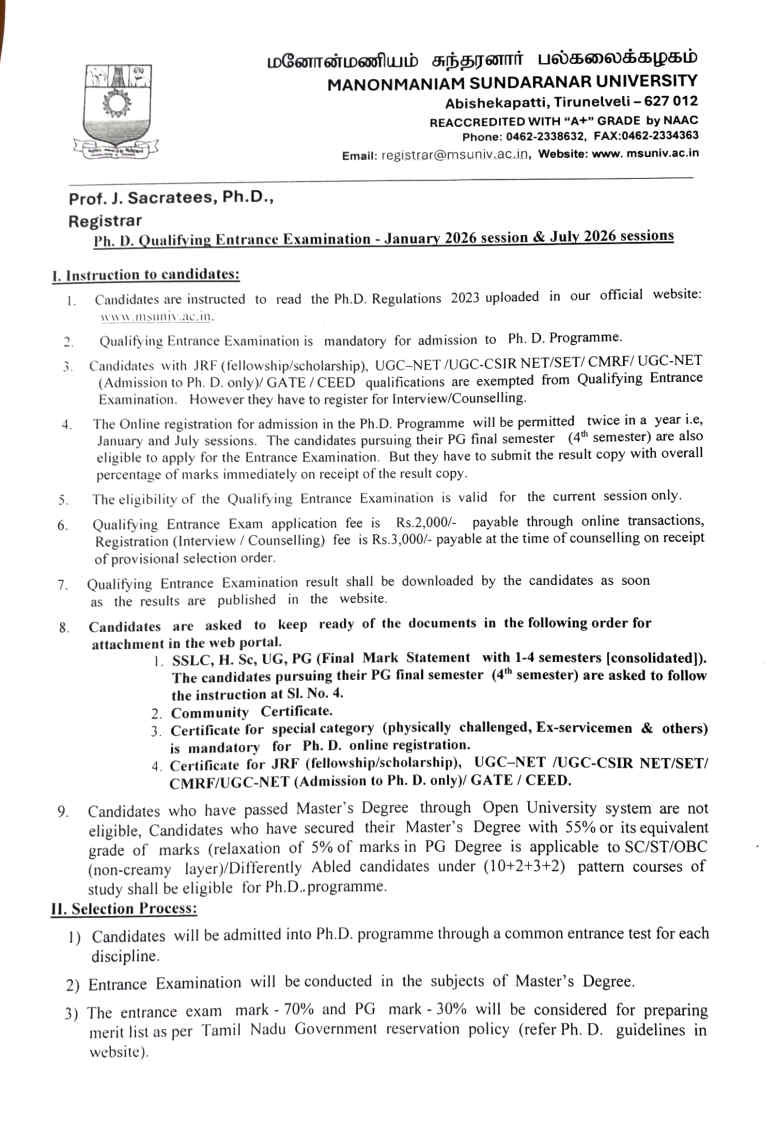
Manonmaniam Sundaranar University
- Eligibility (master’s marks)
A master’s with 55% in the same or an allied subject. SC, ST, OBC (non-creamy layer) and differently abled candidates need 50% (clause 3). Open University master’s degrees are not accepted.
- Entrance test and NET/JRF
A two-hour, 70-mark objective test in your master’s subject. Merit is 70% entrance marks and 30% PG marks. The 2026 notification exempted JRF, UGC-NET, CSIR-NET, SET, CMRF, NET (Ph.D. only), GATE and CEED holders. Clause 4.7 ranks NET-JRF first, then NET, then SET, then test-takers.
- Coursework
At least 12 credits, including research methodology and Research and Publication Ethics. You need 55% to continue (clause 9).
- Duration: full-time
Three to six years (clause 5.1(3)).
- Duration: part-time
Four to six years (clause 5.2(2)).
- Papers before submission
Two papers in UGC-CARE-listed journals, or one granted patent, before the synopsis. You must be first author, or second with your supervisor first. The papers carry the MSU affiliation and go on your Vidwan profile (clause 11.2). You also present two papers at seminars or conferences.
- Similarity limit
“Similarities upto 10% be accepted (via Drillbit software)” (clause 11.4). You submit the thesis within 15 days of the check.
- Thesis format
MS Word in Times New Roman 12 pt (clause 11.7(6)), double-spaced, at least 20 lines a page. 100 to 400 pages from Chapter 1, references not counted. Three soft-bound copies printed on both sides.
Our guide: Manonmaniam Sundaranar University PhD admission. Thesis format: Manonmaniam Sundaranar University PhD thesis format. Official regulation: Revised Ph.D. Regulations 2023.
Documents behind this card:
Osmania University
- Eligibility (master’s marks)
A master’s in the subject with 55%, or 50% for SC, ST, BC, PWD and EWS candidates (Category-II notification, 24 August 2026). Rule 3 also accepts an M.Phil. with 55% or a four-year bachelor’s with 75%. Your PG result must be out before you apply.
- Entrance test and NET/JRF
Category-II is a 90-minute, 100-question computer test scaled to 70 marks, plus a 30-mark interview. You qualify with 45% (Open), 40% (BC, EWS) or 35% (SC, ST, PwD) (rule 7.2(c)). Category-I is interview only, for JRF holders, DST-INSPIRE, NFSC, NFST, NFPWD, FIP and QIP fellows (rule 6.1). NET without JRF gives no exemption.
- Coursework
One semester of four papers: Research and Publication Ethics (2 credits), Research Methodology (4), an advanced subject paper (4) and Artificial Intelligence (2) (rule 20.4). You need 55% in every paper (rules 21.5 and 21.6). A regular-mode M.Phil. with the same coursework exempts you (rule 20.2).
- Duration: full-time
Minimum four years, including coursework. Maximum six years, with up to two more by re-registration (rule 4). Clause 27.1 lets a full-time scholar submit after three years of research, counted from joining.
- Duration: part-time
Minimum five years, including coursework. Maximum six years, with up to two more by re-registration (rule 4). Clause 27.1 lets a part-time scholar submit after four years of research, counted from joining.
- Papers before submission
Two papers from the thesis work, co-authored with your supervisor, in journals indexed in Scopus or Web of Science (rule 25).
- Similarity limit
A similarity index of 10% or less, and AI-generated content similarity of 20% or less, on the university’s approved software (clause 28.1). You sign an undertaking with both figures (clause 27.4(a)).
- Thesis format
Both sides of A4, Times New Roman 12 point, 1.5 spacing (clause 27.13). References follow one standard style: APA 7th, IEEE, Harvard or Oxford. Four soft-bound copies and a CD go to the Controller of Examinations.
Our guide: Osmania University PhD admission. Thesis format: Osmania University PhD thesis format. Official regulation: Ph.D. Rules and Regulations 2026-2027.
Documents behind this card:
Savitribai Phule Pune University (SPPU)
- Eligibility (master’s marks)
55% in a master’s, or 75% in a four-year bachelor’s, or 55% in an M.Phil. A 5% relaxation applies to SC, ST, DT-A, NT-B, NT-C, NT-D, SEBC, OBC (non-creamy layer), EWS and differently-abled candidates. A reservation claim counts only for candidates from Maharashtra.
- Entrance test and NET/JRF
The Ph.D. Entrance Test (PET) is half research methodology, half subject (clause 3.2(c)(ii)). You need 50% (5% relaxation), and selection is 70% PET, 30% interview. UGC-NET, CSIR-NET, SET, a valid GATE, JRF or SRF and similar results exempt you, and a 100-mark interview decides (3.2(c)(i)). No PET had been held since 2024 when we checked.
- Coursework
16 credits: research methodology (4), two advanced subject courses (8), Research and Publication Ethics (2), a seminar or conference (1) and pedagogy or an industrial visit report (1) (clause 8.3). You need 55% within two years of registration.
- Duration: full-time
The minimum is three years. The synopsis waits until 36 months after registration (clause 10.8). The guide gives no maximum.
- Duration: part-time
Not stated in the regulations we checked. See the official regulation. Amended Ordinance 186 (Circular 157/2026)
- Papers before submission
At least one paper in a Scopus or UGC-CARE listed journal (clause 10.10). SPPU’s own publication guidelines also apply.
- Similarity limit
“Less than or equal to 10%”, checked as per UGC regulations, with a certificate of the check (clause 10.15).
- Thesis format
A4, printed on both sides, 1.5 spacing, 1.5-inch left margin (clause 10.12). A black hard-bound cover, and the spine shows “Ph.D. thesis”, your name, and the month and year. No font, font size or page count is set.
Our guide: SPPU PhD admission. Thesis format: SPPU (Savitribai Phule Pune University) PhD thesis format. Official regulation: Amended Ordinance 186 (Circular 157/2026).
Documents behind this card:
University of Calcutta
- Eligibility (master’s marks)
A master’s or M.Phil. with 55%, or a four-year bachelor’s with research with 75%. Reserved categories, EWS included, get five marks off (Regulation 3). You also need a NET, SET, GATE or GPAT result in the department’s subject (Regulation 4.2).
- Entrance test and NET/JRF
NET Category 1 (JRF) is judged on the interview, with priority for seats. NET Categories 2 and 3, WB SET, GATE and GPAT are ranked 70% on the score and 30% on a 100-mark interview. The NET mark is valid for one year for admission (Regulation 4.2).
- Coursework
At least 12 credits within two years, including Research and Publication Ethics and a research methods course (Regulation 9). The pass mark is 55% in each course (50% reserved). Up to 6 credits can come from online courses.
- Duration: full-time
You can submit only after three years from admission (Regulation 11). The guide gives no maximum.
- Duration: part-time
Not stated in the regulations we checked. See the official regulation. Ph.D. Regulations, 2025 (in force from 12 February 2026)
- Papers before submission
Science, agriculture, engineering and technology: at least one Scopus or Web of Science paper, accepted or published, or a granted patent. Other subjects: one paper in a peer-reviewed journal. Everyone: one oral talk at an international conference, or two at national ones (Regulation 11).
- Similarity limit
Similarity must not go above 10%. You must disclose and mark any AI-generated content.
- Thesis format
The thesis is usually in English. A Bengali or bilingual thesis needs the Vice-Chancellor’s permission. Our guides give no layout rules for Calcutta.
Our guide: University of Calcutta PhD admission. Official regulation: Ph.D. Regulations, 2025 (in force from 12 February 2026).
Documents behind this card:
University of Calicut
- Eligibility (master’s marks)
Not stated in the regulations we checked. See the official regulation. Calicut University Research Regulations 2023
- Entrance test and NET/JRF
A two-hour, 100-mark test on research methods and your subject. You need 50% (40% for SC and ST, 45% for OBC non-creamy layer and differently abled). Rank is 70% test or NET mark, 30% interview. JRF and fellowship holders, regular teachers, experienced scientists and UGC-NET or CSIR-NET holders (all categories) skip the test (clause 3.2, 2025 notification). SLET, GATE and M.Phil. holders sit it (regulation 4.3).
- Coursework
12 credits: Research Methodology (4), an elective (4), Research and Publication Ethics (2) and a review of published research (2) (regulation 6). You need 55% at the Preliminary Qualifying Examination.
- Duration: full-time
At least three years including coursework, and at most six. Re-registration can add up to two more. Women and scholars with more than 40% disability can have two further years, up to ten in total.
- Duration: part-time
Not stated in the regulations we checked. See the official regulation. Calicut University Research Regulations 2023
- Papers before submission
One paper in a UGC-CARE-listed journal and two conference or seminar presentations (regulation 8.3). The paper must name the University of Calicut.
- Similarity limit
10% for the non-core chapters and 10% for the core chapters, on the Certificate on Plagiarism Check. This follows U.O. No. 12218/2023/Admn, which adopted the UGC 2018 regulations. The check is at CHMK Library.
- Thesis format
Printed on both sides, with references in 10 or 11 point at single spacing (U.O. No. 9330/2022/Admn). A chapter titled “Recommendations” is compulsory. One-page abstracts in English and Malayalam. Paper size, margins and font are not stated.
Our guide: University of Calicut PhD admission. Thesis format: University of Calicut PhD thesis format. Official regulation: Calicut University Research Regulations 2023.
Documents behind this card:
University of Delhi
- Eligibility (master’s marks)
55% in a master’s, or a four-year bachelor’s with 75% followed by a master’s, or an M.Phil. with 55%. Reserved categories, EWS and differently-abled candidates get five points off (clause C.1). Master’s-degree applicants must also qualify NET, CSIR-NET, GATE, CEED or a similar national test (clause C.1.2).
- Entrance test and NET/JRF
DU holds no written entrance in the regular call. Merit is 70% national test score and 30% interview, for every candidate (clause D.2). JRF holders are placed in Block A, ahead of other NET qualifiers. A few departments hold their own tests.
- Coursework
12 to 16 credits, including a two-credit Research and Publication Ethics course and a four-credit research methodology course, done in the first year (clause E). You need 55%, with one reappearance, all within 18 months. Two-thirds attendance in each course is compulsory (clause F).
- Duration: full-time
Not stated in the regulations we checked. See the official regulation. Ordinance VI, revised 20 August 2026
- Duration: part-time
Not stated in the regulations we checked. See the official regulation. Ordinance VI, revised 20 August 2026
- Papers before submission
On the academic pathway (clause M.5.1): two conference presentations and two papers in Scopus-indexed or DU-approved journals, as first, second or corresponding author. A granted patent can replace the two papers. A product or application-based pathway (clause M.5.2) has its own rules.
- Similarity limit
The Ordinance gives no percentage. The University Library checks every thesis on DrillBit (clause M.6), and you submit within 30 days of the check. The forms ask your supervisor to confirm “accepted norms”, and clause M.13 points to the UGC 2018 regulations.
- Thesis format
Ordinance VI sets no paper size, margins, font, spacing, page limit or citation style. You submit one typed, double-sided, softbound copy and upload a PDF (clause M.14).
Our guide: Delhi University PhD admission. Thesis format: University of Delhi PhD thesis format. Official regulation: Ordinance VI, revised 20 August 2026.
Documents behind this card:
University of Hyderabad
- Eligibility (master’s marks)
55% in the master’s for General and EWS candidates, and 50% for SC, ST, OBC and PwD. This follows the UGC 2022 rules, adopted by the 91st Academic Council on 6 April 2023. Some programmes admit four-year honours-with-research graduates with 75%.
- Entrance test and NET/JRF
In 2026-27, 28 programmes used the university’s 70-mark test and a 30-mark interview. You need 50%, or 45% for SC, ST, OBC-NCL and PwD. Category-1 JRF holders skip the test, and their interview score is scaled to 100. Seventeen other programmes used a UGC-NET or CSIR-NET score, then an interview.
- Coursework
12 to 14 credits, with an ethics paper and a methodology paper among them. You need 55% to confirm registration.
- Duration: full-time
Not stated in the regulations we checked. See the official regulation. Prospectus 2026-27
- Duration: part-time
Not stated in the regulations we checked. See the official regulation. Prospectus 2026-27
- Papers before submission
Not stated in the regulations we checked. See the official regulation. Prospectus 2026-27
- Similarity limit
Not stated in the regulations we checked. See the official regulation. Prospectus 2026-27
- Thesis format
Not stated in the regulations we checked. See the official regulation. Prospectus 2026-27
Our guide: University of Hyderabad PhD admission. Official regulation: Prospectus 2026-27.
Documents behind this card:
University of Kerala
- Eligibility (master’s marks)
A master’s with 55%, or a four-year bachelor’s with 75%. SC, ST, OBC (non-creamy layer), differently abled and EWS candidates get 5 marks off, applied to the marks on your mark list only (July 2026 notice).
- Entrance test and NET/JRF
A three-hour, 100-mark written test: research methodology (50%) and your subject (50%). You need 50% in each part, with 10% relaxation for SC and ST and 5% for OBC, differently abled and EWS. Selection is 70% test, 30% interview. UGC-NET (all three categories), JRF, CSIR-NET, DBT-JRF, DST-INSPIRE, SLET, GATE, approved fellowships, an M.Phil. (B or 55%) and seven years of college teaching exempt you.
- Coursework
At least one semester of coursework worth 14 credits in the first year after registration. Research and Publication Ethics (Paper II) is compulsory for everyone.
- Duration: full-time
Three to six years from admission (clause 4). The Syndicate can add two more. Women scholars and scholars with more than 40% disability can get a further two.
- Duration: part-time
Not stated in the regulations we checked. See the official regulation. Regulations for the Award of Ph.D. Degree, 2022
- Papers before submission
Not stated in the regulations we checked. See the official regulation. Regulations for the Award of Ph.D. Degree, 2022
- Similarity limit
The 2022 regulations give no percentage and name no software. Clause 11(3) says only that the University will detect plagiarism with “well-developed software applications”. You hand in a no-plagiarism undertaking and your supervisor’s originality certificate (clause 11(4)).
- Thesis format
The University has not published a thesis format manual, so you agree paper size, margins, font and binding with your supervisor. The thesis form asks for four copies, plus ten copies of a one-page synopsis without your name.
Our guide: University of Kerala PhD admission. Thesis format: University of Kerala PhD thesis format and submission rules. Official regulation: Regulations for the Award of Ph.D. Degree, 2022.
Documents behind this card:
University of Madras
- Eligibility (master’s marks)
A PG degree with 55%, or B on the UGC seven-point scale, reached through 10+2, then UG, then PG (clause 2.1). SC, ST and differently abled applicants need 50%, as do those with a master’s from before 19 September 1991. Grace marks don’t count (clause 2.2).
- Entrance test and NET/JRF
Each institution sets a 50-mark test: 35 written and 15 oral. You need 25 (clause 3.3). Merit is 50% PG marks and 50% test (clause 3.2.1). UGC-JRF, CSIR-JRF, DBT, DST-INSPIRE and ICMR fellows join without the test (clause 3.1.3). No exemption is named for NET, SET or GATE without a fellowship.
- Coursework
Four courses, 16 credits: Research and Publication Ethics (2), Research Methodology (4), an advanced subject course (5) and a course on your research theme (5). Each is a three-hour, 100-mark paper, and you need 55%. Up to four credits may come from MOOCs.
- Duration: full-time
At least three years and up to six. Re-registration can add up to two years, for ₹10,000 to ₹30,000 a year. An M.Phil. removes one year from the minimum (clause 7.1). Our thesis-format guide reads the rules as allowing no submission after six years, so confirm this with the university.
- Duration: part-time
Not stated in the regulations we checked. See the official regulation. Research Regulations 2021, amended March 2023
- Papers before submission
One paper in a UGC-CARE, Scopus, Web of Science, PubMed or SCI journal before the synopsis. One paper or poster at a seminar or conference before the thesis (clause 12.2). The university’s name must be in the affiliation.
- Similarity limit
The regulations give no percentage. The University Library issues the similarity certificate. The thesis is accepted if the similarity is acceptable “as per the rules framed by the Syndicate from time to time”. Ask the library for the current figure.
- Thesis format
Typed in 12 point at 1.5 or 2.0 spacing, printed on both sides (clause 13.6). White soft binding with the university logo. A Tamil abstract of up to ten pages and a Tamil Virtual Academy certificate. No margins, font face, page limit or citation style are set.
Our guide: University of Madras PhD admission. Thesis format: University of Madras PhD thesis format. Official regulation: Research Regulations 2021, amended March 2023.
Documents behind this card:
University of Mumbai
- Eligibility (master’s marks)
A master’s with 55%, relaxed by five points for reserved categories, EWS and the differently-abled. Or a four-year honours degree with research, with 75% (70% relaxed) (R.PhD.2). Distance-mode degrees from recognised universities count.
- Entrance test and NET/JRF
The university holds PET only where seats exist and no NET, SET, GATE or GPAT covers the subject (R.PhD.5). PET is qualifying at 50% (45% reserved) and valid for a year. UGC-NET (with or without JRF), CSIR-NET, SLET, GATE, INSPIRE, teacher-fellowship and non-distance M.Phil. holders are exempt (R.PhD.6). Each research centre then interviews.
- Coursework
At least 12 credits (180 hours), with at least four credits of research methodology. You need 55% (R.PhD.13). An M.Phil. under UGC norms exempts you (R.PhD.14).
- Duration: full-time
At most six years from admission at the centre (R.PhD.3). Re-registration can stretch it to eight years, or ten for women and scholars with a disability above 40%. Registration must come at least one year before thesis submission (R.PhD.12(4)).
- Duration: part-time
Not stated in the regulations we checked. See the official regulation. Regulations for Ph.D., in force from 1 January 2026
- Papers before submission
Before the synopsis, one published or accepted paper from your PhD work in a Scopus- or Web of Science-listed journal (ABDC where relevant). Also two conference or seminar talks, and a published patent can replace one (R.PhD.17). You and your supervisor must be first or last authors.
- Similarity limit
Up to 10% is Level 0, with no penalty (R.PhD.31). Above 10% to 40% means a revised script within six months.
- Thesis format
The regulations set no paper size, font, spacing, margins, binding or citation style. The thesis may not contain a dedication note (R.PhD.19(9)). One hard copy and one soft copy go in through your supervisor (R.PhD.19(7)).
Our guide: University of Mumbai PhD admission. Thesis format: University of Mumbai PhD thesis format. Official regulation: Regulations for Ph.D., in force from 1 January 2026.
Documents behind this card:
Visvesvaraya Technological University (VTU)
- Eligibility (master’s marks)
Engineering: M.E., M.Tech. or M.S. (Research) with a CGPA of 6.75 or 60% at the bachelor’s or master’s level (clause 23PHD 2.1.1). Management needs 6.75 or 60% at the master’s level. From a four-year bachelor’s, 75%. SC, ST, OBC (non-creamy layer), differently abled and EWS candidates get 5% relaxation (23PHD 2.1.6).
- Entrance test and NET/JRF
The VTU Eligibility Test for Research is half research methodology, half subject (23PHD 4.1). It is 100 multiple-choice marks scaled to 70. You qualify with 35 of 70, or 31 in reserved categories, and a 30-mark interview follows. UGC-NET (with JRF), CSIR-NET, SLET, GATE, CAT, an M.Phil. or a valid ETR score exempts you (23PHD 4.2.2). Exempt candidates fill supervisor vacancies first (23PHD 4.3.4).
- Coursework
12 credits or more, with Research Methodology and Research and Publication Ethics compulsory. You take it through NPTEL or your institution, as the RAC recommends. You need 55% (23PHD 6.1) within two years, then a viva-voce.
- Duration: full-time
Three to six years, extendable by two. Women and candidates with over 40% disability get two more.
- Duration: part-time
Not stated in the regulations we checked. See the official regulation. Ph.D. Regulations 2023
- Papers before submission
The 2026 thesis checklist (item 13) asks recent batches for one paper in a Q1 to Q3 Scopus-indexed journal. Older batches may show two UGC-CARE or two Scopus, SCI or Web of Science papers instead. The 2023 regulations ask for two such papers before the pre-submission colloquium. Your name and your guide’s must be on the paper.
- Similarity limit
VTU’s documents differ. The anti-plagiarism procedure on its PhD formats page allows 25% or less. The PhD Manual 2024 says 10% or less, leaving out the bibliography, index and references. Our guide suggests aiming for 10%.
- Thesis format
The July 2025 THESIS FORMAT template fixes the page order, and VTU fines theses not in it. An older guideline sets A4, 1.5 spacing, 12-point body text and margins of 1.25″ left, 1″ right, and 0.75″ top and bottom. References are numbered in order of citation.
Our guide: VTU PhD admission. Thesis format: VTU PhD thesis format. Official regulation: Ph.D. Regulations 2023.
Documents behind this card:
- VTU, Minimum Standards and Procedure for Award of Ph.D. Degree, Regulations 2023 (PDF)
- VTU, VTU-ETR-2026 notification, 31 August 2026 (PDF)
- VTU, thesis check list, March 2026 (PDF)
- VTU, Ph.D. Manual 2024 (PDF)
- VTU, THESIS FORMAT circular, 15 July 2025 (PDF)
- VTU, Ph.D. by research page: formats and anti-plagiarism procedure
Method
How this tool works
We built the data from what this site already says, with sources. There were three kinds of guide. The 20 university admission guides gave us eligibility, the entrance test, coursework and duration. The thesis-format guides gave us the layout, the similarity limit and often the paper rule. And our guides on plagiarism limits, the publication requirement and part-time PhDs filled some gaps. We copied each rule as the guide states it, with the clause number where the guide gives one. We added nothing from anywhere else.
Where our guides don’t state a rule for a university, the card says so plainly and links the official regulation. We don’t guess. That is why some cards have gaps. The UGC column comes from our national admission guide and the guides on coursework, timelines and publication. The similarity figure in that column is from the UGC’s separate 2018 plagiarism regulations.
To spot differences, each rule carries a short summary, such as “10%” or “Min 3 years; max 6”. When you compare two universities, a row is marked if those summaries differ. So read the full text in both columns before you rely on a mark. We compiled the data on 28 September 2026, from guides last reviewed in September 2026.
Universities change their rules by circular, often mid-year. So always confirm with your university’s current notification before you apply, register or submit. The university guides list the documents we read and when.
Limits
What this tool can’t do
FAQ
Frequently asked questions
Why does a card say “Not stated in the regulations we checked”?
Because our guide for that university doesn’t state the rule, and we fill the tool only from our guides. The rule may still exist in the regulation, or in a circular we haven’t read. Open the official regulation from the card, or ask the research section.
Is the UGC 2022 column the rule at my university?
It is the floor. Universities must meet it and may ask for more, such as more coursework credits, a longer minimum or published papers. Where the card and the UGC column differ, your university’s own rule is the one you follow.
Do I still need a published paper to submit my thesis?
The UGC 2022 regulations don’t require one. But most universities in this tool do, through their own ordinances. Our publication requirement guide explains the change and how to find your own rule.
Why do VTU’s similarity figures say 25% or 10%?
Because VTU’s own documents disagree. Its PhD formats page allows 25%, and its PhD Manual 2024 says 10%. Our VTU guide suggests aiming for 10%, which meets both. Our plagiarism limits guide explains the UGC levels.
How do I share a comparison?
Choose two universities and press “Copy link to this comparison”. The link ends in the two names, such as #anna-university-vs-university-of-madras. Whoever opens it sees the same comparison.
How current is this data?
We compiled it on 28 September 2026, from guides last reviewed in September 2026. Rules change by circular, so always confirm with your university’s current notification. If you spot a rule that has changed, tell us and we’ll update the guide and the tool.
Evidence
Sources
- UGC Ph.D. Regulations, 2022, Gazette of India, 7 November 2022 (PDF)
- UGC (Promotion of Academic Integrity and Prevention of Plagiarism) Regulations, 2018 (PDF)
- Anna University: Ph.D. Regulations R2025
- Annamalai University: Ph.D. Prospectus 2026-27 (University Departments), with the regulations
- Banaras Hindu University (BHU): Ph.D. Ordinance (2016, as amended)
- Bangalore University: Regulations Governing the Degree of Doctor of Philosophy, 2024
- Bharathiar University: Ph.D. Regulations 2025–26
- Bharathidasan University: Ph.D. Regulations 2026
- JNTU Hyderabad (JNTUH): Ph.D. Academic Regulations and Guidelines, 2021-22 onwards
- Jawaharlal Nehru University (JNU): Ph.D. Ordinance 2022 (Ordinance 13(B)) in the Academic Ordinances
- Madurai Kamaraj University: M.Phil./Ph.D. Regulations 2016, with later amendments
- Manonmaniam Sundaranar University: Revised Ph.D. Regulations 2023
- Osmania University: Ph.D. Rules and Regulations 2026-2027
- Savitribai Phule Pune University (SPPU): Amended Ordinance 186 (Circular 157/2026)
- University of Calcutta: Ph.D. Regulations, 2025 (in force from 12 February 2026)
- University of Calicut: Calicut University Research Regulations 2023
- University of Delhi: Ordinance VI, revised 20 August 2026
- University of Hyderabad: Prospectus 2026-27
- University of Kerala: Regulations for the Award of Ph.D. Degree, 2022
- University of Madras: Research Regulations 2021, amended March 2023
- University of Mumbai: Regulations for Ph.D., in force from 1 January 2026
- Visvesvaraya Technological University (VTU): Ph.D. Regulations 2023
Keep reading
Related guides and services
PhD admission in India
Eligibility, entrance routes and the interview under the UGC 2022 regulations.
Plagiarism limits for PhD theses in India
The UGC 2018 levels, what’s excluded from the count, and how to read your similarity report.
Is publication mandatory for a PhD in India after UGC 2022?
What UGC 2022 changed about publishing before submission, and what universities still ask for.
PhD timeline planner
Your earliest and latest submission dates under UGC 2022, with a milestone plan you can add to your calendar.

Talk it through with a specialist for free
Send us where you are and what you need. We’ll reply within one working day with clear advice, a written scope and a fixed quote. No obligation.
Book a free consultation